
Thanks! We’ll be in touch with you soon.
Thanks! We’ll be in touch with you soon.
Thanks! We've emailed it to you.
The AI Transformation: Why 2026 Will Separate Digital Winners from Laggards in Credit Unions
Cotribute CEO Philip Paul on why intelligent AI integration—not just digital features—will define competitive success
"In 2026, the competitive edge will not just come from offering digital features, but from intelligently integrating AI."
That's the prediction Philip Paul, CEO of Cotribute, shared in a recent [BankNews roundup] featuring perspectives from financial technology leaders on the year ahead.
While many credit unions have spent the past few years adding "digital" to their capabilities—mobile apps, online banking, digital account opening—2026 marks a critical inflection point.
The question is no longer "Are you digital?" It's "Are you intelligent?"
And for credit unions, that distinction will determine who grows and who gets left behind.
Informed by 500+ Leader Conversations with Credit Union and Bank Leaders — The Executive Growth Workspace delivers the market intelligence, strategic tools, ROI frameworks, and competitive insights that the fastest growing Credit Unions and Banks use to drive digital growth (for free!). Explore Now →
From Digital Features to Intelligent Operations
Let's be honest: having a mobile app in 2026 isn't innovative. It's table stakes.
Credit unions have been playing catch-up on digital for years:
- Adding online account opening (often with clunky multi-step processes)
- Implementing mobile banking (sometimes with features that don't work on all devices)
- Offering digital loan applications (that still require branch visits to complete)
These are necessary capabilities. But they're also the bare minimum.
The problem? Digital features alone don't create competitive advantage anymore. Every credit union, every bank, every fintech has them.
What creates advantage in 2026 is how intelligently those digital features work—how seamlessly they serve members, how efficiently they operate behind the scenes, and how little friction they introduce into the member journey.
That's where AI changes everything.
The AI Shift: From Experimentation to Production
For the past two years, credit unions have been experimenting with AI:
- Chatbots for member service
- Fraud detection systems
- Back-office automation
- Marketing personalization
2026 is different. AI moves from experimental project to operational necessity.
As Philip noted in the BankNews article, AI integration is shifting "from optional add-on to core operational necessity."
What does that mean in practice?
It means AI becomes invisible infrastructure, not a separate tool:
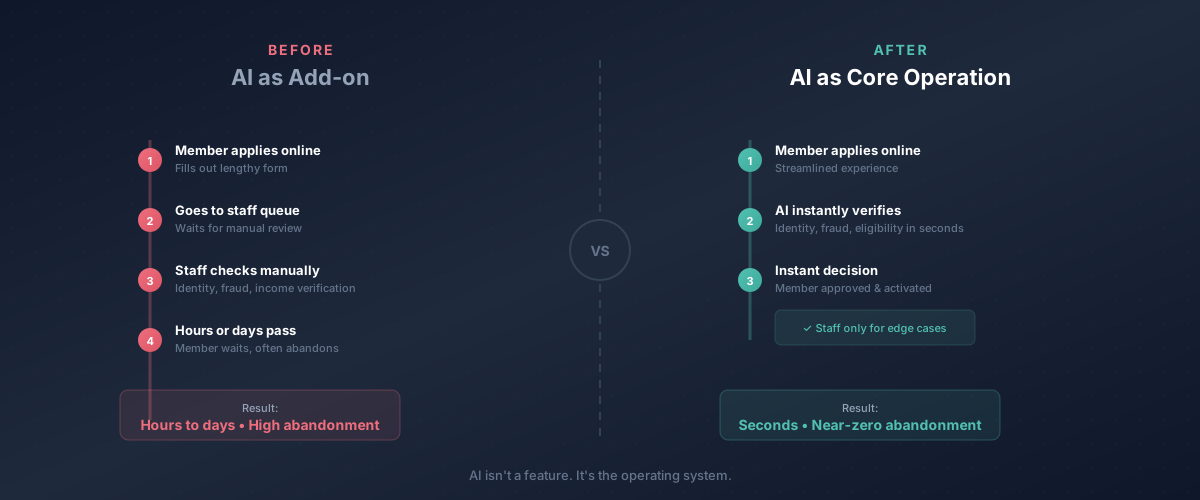
Before (AI as Add-on):
- Member applies for account online
- Application goes to staff for manual review
- Staff checks identity, runs fraud checks, verifies income
- Process takes hours or days
- Member waits, often abandons application
After (AI as Core Operation):
- Member applies for account online
- AI instantly verifies identity, assesses fraud risk, evaluates eligibility
- Decision made in seconds, not hours
- Member approved and activated immediately
- Staff only intervenes for edge cases requiring human judgment
The shift: AI isn't a feature. It's the operating system.
The Zero-Click Revolution: Friction-Free Onboarding
Philip's prediction for 2026: "Banks achieving 'zero-click' or 'zero-visit' experiences for account opening and loan applications will gain competitive advantages."
Let's unpack what "zero-click" means for credit unions.
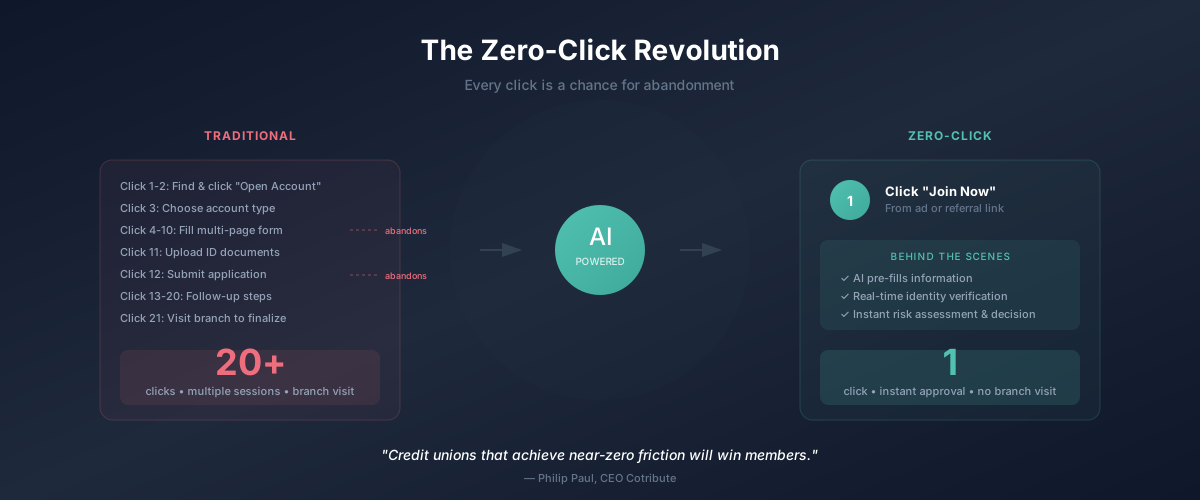
Traditional Digital Account Opening:
Click 1: Visit credit union website
Click 2: Find "Open an Account" button
Click 3: Choose account type
Click 4-10: Fill out multi-page form with personal information
Click 11: Upload identification documents
Click 12: Submit application
Click 13-20: Wait for email, log back in, complete additional steps
Click 21: Visit branch to finalize (often required)
Total: 20+ clicks, multiple sessions, branch visit
Zero-Click Account Opening:
Click 1: Member clicks "Join Now" from targeted ad or referral link
Behind the scenes: AI pre-fills information, verifies identity in real-time, assesses risk, makes instant decision
Result: Account opened, member activated, ready to use
Total: 1 click, instant approval, no branch visit
Why This Matters:
Every click is a chance for abandonment. Every form field. Every page load. Every "come back later" or "visit a branch to complete."
Gen Z doesn't wait. Millennials don't have patience for multi-step processes. Even older members are conditioned by Amazon, Uber, and every other digital experience to expect instant gratification.
Credit unions that achieve near-zero friction in 2026 will win members. Those that require 20 clicks and a branch visit will lose them.
AI-Powered Onboarding: The Technical Reality
Let's get specific about what AI-powered digital onboarding actually does.
1. Intelligent Identity Verification
Traditional approach: Member uploads driver's license photo. Staff manually reviews, compares to application data, verifies authenticity.
AI approach:
- Instantly extracts data from ID document
- Verifies document authenticity (detects forgeries)
- Performs liveness detection to prevent identity theft
- Cross-references against fraud databases
- Makes pass/fail decision in seconds
Impact: 82% reduction in manual reviews (as CPM Federal Credit Union experienced)
2. Automated Risk Assessment
Traditional approach: Staff manually reviews application against risk criteria, makes subjective decision based on experience and policy.
AI approach:
- Analyzes hundreds of risk signals simultaneously
- Scores fraud probability based on behavioral patterns
- Compares to historical data and known fraud patterns
- Provides consistent, objective risk assessment
- Flags only high-risk cases for human review
Impact: Faster decisions, fewer false positives, consistent policy application
3. Smart Document Processing
Traditional approach: Member submits documents, staff manually reviews, extracts information, enters into system.
AI approach:
- Automatically extracts text from uploaded documents
- Identifies document type (pay stub, tax return, utility bill, etc.)
- Populates application fields with extracted data
- Verifies information against application
- Flags discrepancies for human review
Impact: Hours of staff time saved per application
4. Predictive Member Qualification
Traditional approach: Member fills out application, discovers they don't qualify, abandons process frustrated.
AI approach:
- Pre-qualifies member based on initial information
- Routes to appropriate account types
- Suggests products member is likely to qualify for
- Prevents wasted time on applications that won't be approved
Impact: Higher approval rates, better member experience, reduced abandonment
Beyond Onboarding: AI Across the Member Journey
While digital account opening is where AI delivers immediate impact, the intelligent integration Philip describes extends across every member touchpoint.
AI in Lending:
- Automated income analysis from documents
- Instant credit decisions for qualified applicants
- Intelligent loan product recommendations
- Predictive models for default risk
AI in Fraud Prevention:
- Real-time transaction monitoring
- Behavioral pattern analysis
- Suspicious activity detection
- Account takeover prevention
AI in Member Service:
- Intelligent chatbots for routine questions
- Automated issue resolution
- Predictive service (identifying problems before members report them)
- Personalized product recommendations
AI in Compliance:
- Automated KYC/AML checks
- Regulatory reporting
- Risk monitoring
- Audit trail documentation
The pattern: AI handles routine, rules-based tasks. Humans handle complex, judgment-based situations.
.svg)
Human-Centered Service + AI Technology = Competitive Advantage
Here's where Philip's prediction gets interesting for credit unions:
"Human-centered service models amplified by technology will differentiate community banks from larger fintech competitors."
This is the credit union secret weapon.
Big banks have technology. Fintechs have speed.
What credit unions have: Personal relationships, community connection, and member-first values.
What credit unions often lack: The technology to deliver on those values efficiently.
AI changes the equation.
Example: Member applies for a loan
Without AI:
- Application sits in queue for hours or days
- Staff manually processes, creates delays
- Member calls to check status, waits on hold
- Process takes a week, member frustrated
With AI:
- Application instantly processed, routine cases auto-approved
- Complex cases flagged for immediate staff review
- Staff time freed to focus on members who need help
- Member gets decision in minutes for standard cases, hours for complex ones
- Staff can proactively call members with questions, not just react to inquiries
Result: Technology enables better human service, not replacing it.
The 2026 Competitive Landscape: Winners and Laggards
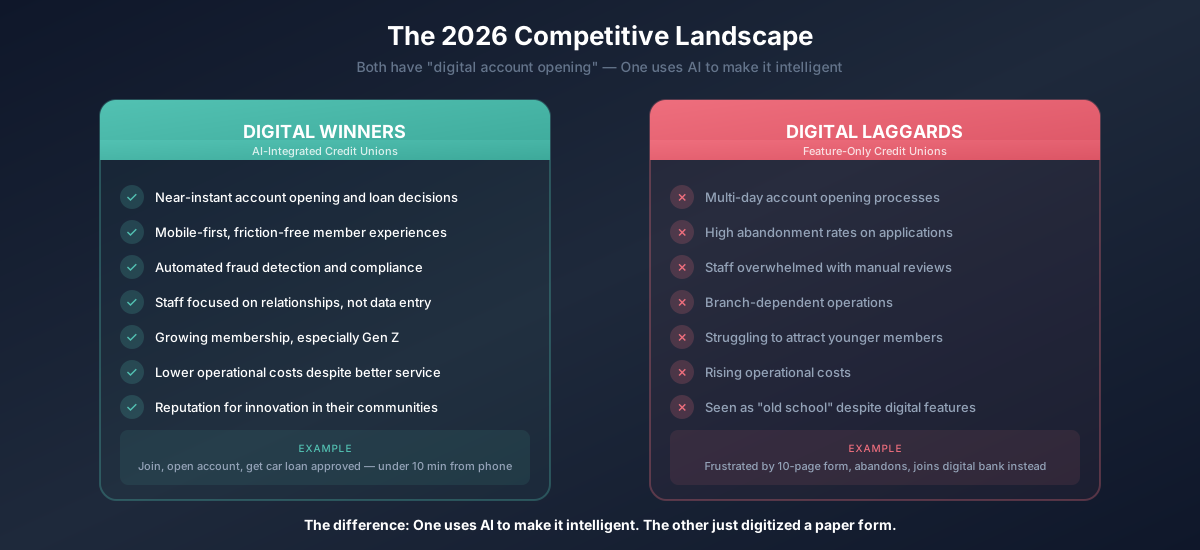
Based on Philip's predictions and current industry trends, here's what 2026 will look like:
Digital Winners (AI-Integrated Credit Unions):
✅ Near-instant account opening and loan decisions
✅ Mobile-first, friction-free member experiences
✅ Automated fraud detection and compliance
✅ Staff focused on relationship-building, not data entry
✅ Growing membership, especially Gen Z and Millennials
✅ Lower operational costs despite better service
✅ Reputation for innovation in their communities
Example: A member can join the credit union, open an account, get approved for a car loan, and schedule a consultation with a loan officer—all in under 10 minutes from their phone while sitting at the dealership.
Digital Laggards (Feature-Only Credit Unions):
❌ Multi-day account opening processes
❌ High abandonment rates on digital applications
❌ Staff overwhelmed with manual reviews
❌ Branch-dependent operations
❌ Struggling to attract younger members
❌ Rising operational costs
❌ Seen as "old school" despite having digital features
Example: A member starts an account application online, gets frustrated with a 10-page form, abandons it halfway through, and joins a digital-first bank instead.
The Gap:
Both credit unions have "digital account opening." One uses AI to make it intelligent. The other just digitized a paper form.
That difference determines competitive success.
Regulatory Reality: AI Compliance in 2026
One critical trend Philip's fellow fintech leaders highlighted in the BankNews article: Regulators are demanding clearer documentation and guardrails for AI systems.
This isn't optional. Credit unions implementing AI in 2026 must address:
1. Model Explainability
- How does your AI make decisions?
- Can you explain why an application was approved or denied?
- Are the criteria transparent and consistent with policy?
2. Bias Prevention
- Does your AI system treat all members fairly?
- Are there disparate impacts on protected classes?
- How do you audit for bias?
3. Human Oversight
- When do humans review AI decisions?
- What overrides are allowed?
- How are edge cases handled?
4. Data Privacy
- What data does AI use?
- How is member information protected?
- Who has access to AI-generated insights?
5. Vendor Risk Management
- If using third-party AI, how is it validated?
- What testing has been done?
- How are updates and changes managed?
The good news: Credit unions partnering with purpose-built fintech solutions like Cotribute get AI systems designed with compliance built in, not bolted on later.
The challenge: Credit unions building AI systems in-house or cobbling together multiple tools must ensure each component meets regulatory standards.
The Unified Platform Advantage
Philip's prediction includes a key phrase that often gets overlooked: **"unified digital origination platforms combined with AI."**
"Unified" is the critical word.
The Problem with Piecemeal AI:
Many credit unions approach digital transformation by adding tools one at a time:
- AI chatbot from Vendor A
- Digital account opening from Vendor B
- Loan origination system from Vendor C
- Fraud detection from Vendor D
- Core banking system from Vendor E
Result: Systems don't talk to each other. Data is siloed. AI can't learn across platforms. Member experience is fragmented.
The Unified Platform Approach:
One integrated system for digital origination with AI built in:
- Member data flows seamlessly
- AI learns from complete member journey
- Decisions are informed by full context
- Experience is consistent across products
- Staff has single source of truth
Result: Better AI, better experience, better outcomes.
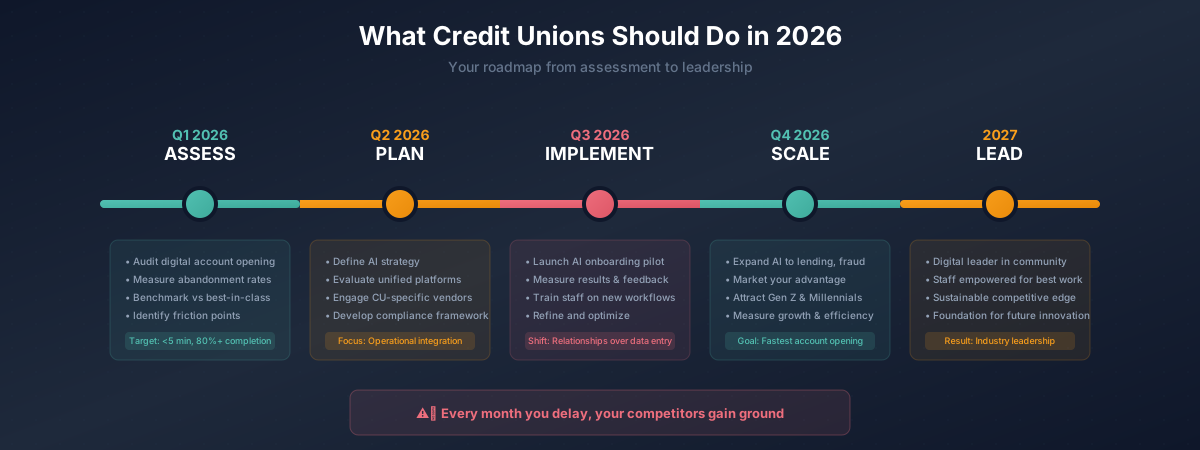
What Credit Unions Should Do in 2026
If Philip's predictions are correct—and the evidence suggests they are—here's what credit union leaders should prioritize:
Q1 2026: Assess
- Audit your current digital account opening process
- Measure abandonment rates, completion times, manual review burden
- Benchmark against best-in-class (hint: under 5 minutes, >80% completion)
- Identify friction points and manual processes
Q2 2026: Plan
- Define your AI strategy (not just features, but operational integration)
- Evaluate unified platform solutions vs. piecemeal tools
- Engage vendors with credit union-specific AI expertise
- Develop compliance and oversight framework
Q3 2026: Implement
- Launch pilot with AI-powered digital onboarding
- Measure results: completion rates, staff time savings, member feedback
- Train staff on new workflows (fewer manual reviews, more relationship focus)
- Refine and optimize based on data
Q4 2026: Scale
- Expand AI to additional use cases (lending, fraud detection, service)
- Market your competitive advantage (fastest account opening, instant decisions)
- Attract Gen Z and Millennial members with friction-free experience
- Measure growth and efficiency gains
2027: Lead
- Credit union becomes known as digital leader in community
- Staff empowered to do best work (relationships, not data entry)
- Sustainable competitive advantage built on intelligent operations
- Foundation for future innovation
The Cost of Waiting
Here's the uncomfortable truth: Every month you delay AI integration, your competitors gain ground.
Consider:
- Members who abandon your application complete one at a digital-first competitor
- Staff time spent on manual reviews that could be automated
- Gen Z prospects who never even try your institution because they assume you're outdated
- Operational costs that keep rising as transaction volumes increase
Meanwhile, AI-powered credit unions are:
- Growing membership 30%+ year-over-year
- Reducing operational costs despite adding services
- Building reputation as innovative leaders
- Attracting top talent who want to work with modern technology
The gap compounds. A 10% growth advantage this year becomes 20% next year becomes 40% in three years.
By then, catching up isn't just expensive. It's existential.
Zero-Click Isn't Science Fiction. It's 2026.
When Philip talks about "zero-click" account opening, it sounds futuristic.
It's not. It's happening now.
CPM Federal Credit Union already proved it:
- 32% increase in new accounts in 90 days
- 82% reduction in manual fraud reviews
- Implementation so smooth they asked us to slow down
That's not theory. That's reality.
And it's powered by intelligent AI integration, not just digital features.
The Choice Credit Unions Face
2026 is the year the digital divide becomes permanent.
Credit unions that intelligently integrate AI will pull ahead—faster growth, better service, lower costs, stronger competitive position.
Credit unions that just add digital features will fall behind—higher costs, slower service, shrinking membership, eventual irrelevance.
The choice isn't whether to adopt AI. It's whether to do it intelligently or haphazardly.
As Philip said: "The competitive edge will not just come from offering digital features, but from intelligently integrating AI."
That intelligence—the strategic, unified, member-first integration of AI into core operations—is what separates winners from laggards in 2026.
Read the full BankNews roundup: Artificial Intelligence: Biggest Factor in Industry Predictions for 2026]
Which will your credit union be?
Informed by 500+ Leader Conversations with Credit Union and Bank Leaders — The Executive Growth Workspace delivers the market intelligence, strategic tools, ROI frameworks, and competitive insights that the fastest growing Credit Unions and Banks use to drive digital growth (for free!).
About Philip Paul
Philip Paul is the CEO and founder of Cotribute, a digital account opening platform purpose-built for credit unions. With a background in fintech innovation and financial services technology, Philip has dedicated his career to helping credit unions compete in a digital-first world while maintaining the member-centric values that define the credit union movement
