
Thanks! We’ll be in touch with you soon.
Thanks! We’ll be in touch with you soon.
Thanks! We've emailed it to you.
.svg)
The Real ROI of Digital Account Opening
Why the numbers behind digital origination matter more than you think
Every CEO and board member in banking eventually asks the same question about digital transformation: “What’s the return?” It’s a fair question. After years of technology investments that promised transformation but delivered incremental change, skepticism is warranted. But when it comes to digital account opening, the ROI story is no longer theoretical. It’s measurable, it’s compelling, and for institutions that get it right, it’s accelerating.
The challenge is that most financial institutions are measuring the wrong things—or not measuring at all. According to CUNA Strategic Services, 40% of credit union executives don’t know their member acquisition cost. If you don’t know what it costs to acquire a new account holder, how can you calculate the return on the platform that’s supposed to make acquisition faster and cheaper?
This post breaks down the real ROI of digital account opening—not invague promises, but in the specific financial levers that drive measurable impact for banks and credit unions.
Beyond “Going Digital”: Reframing the ROI Conversation
Too often, the business case for digital account opening gets reduced to a single metric: the number of accounts opened online. That metric matters, but it only tells part of the story. The real ROI sits across five interconnected financial levers.
1. Acquisition Cost Reduction
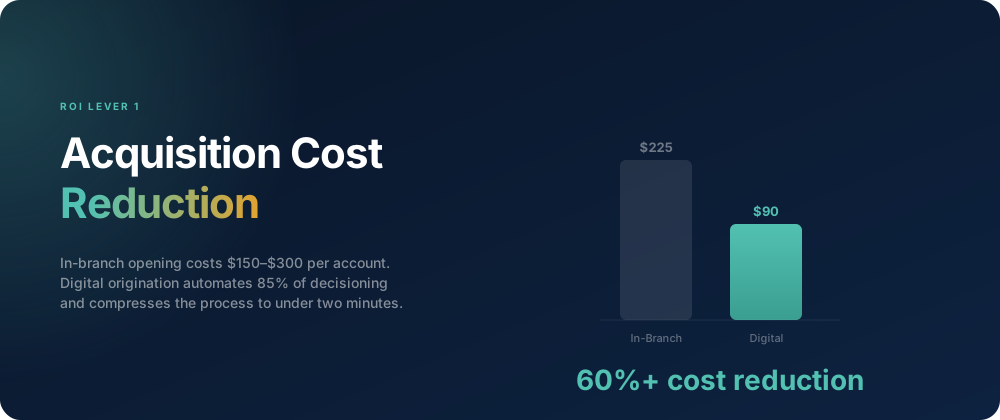
Traditional in-branch account opening carries significant overhead. Staff time, paper processing, manual identity verification, and data entry errors all add up. Industry estimates place the cost of opening a single account in-branch anywhere from $150 to $300 when you factor in fully loaded staff costs, compliance overhead, and error remediation.
A modern digital account opening platform compresses that process to under two minutes and automates roughly 85% of the decisioning. The result is a dramatic reduction in per-account acquisition cost—often by 60% or more. For an institution opening 10,000 new accounts annually, that’s a potential savings of $1 million or more per year in operational costs alone.
60%+ Reduction in per-account acquisition cost with automated digital origination
2. Conversion Rate Uplift
Here’s a number that should keep executives up at night: the average abandonment rate on digital account applications in banking hovers between 60% and 80%, according to multiple industry studies. That means for every ten people who start opening an account online, as few as two actually finish.
The culprit is almost always friction—too many screens, redundant data entry, clunky identity verification, or a process that forces applicantsto visit a branch to finish what they started online. A well-designed digital origination platform addresses each of these pain points. Institutions that deploy streamlined, mobile-first account opening routinely see conversion rates improve by 40% to 60%. That’s not a marginal gain. It’s the difference between a digital channel that bleeds prospects and one that reliably converts them.
40–60% Improvement in application completion rates with frictionless digital workflows

3. Speed to Funding
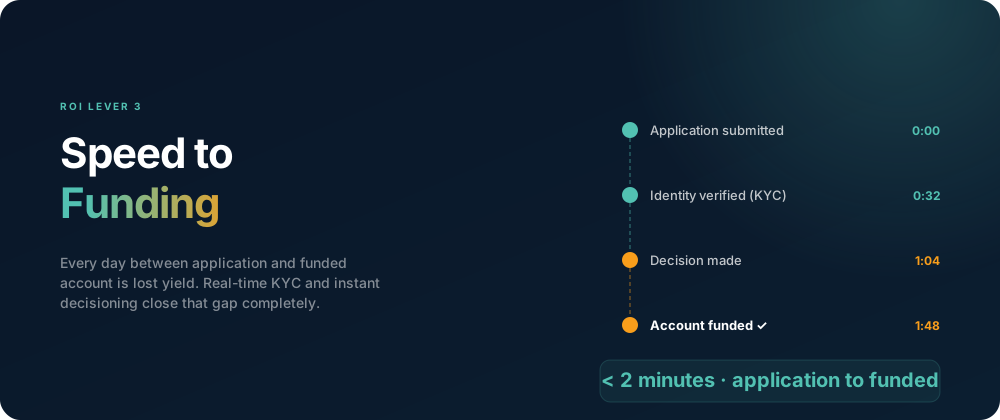
Time-to-funding is one of the most underappreciated metrics in account origination. Every day between application and a funded account is a day the institution isn’t earning on that deposit and a day the applicant might change their mind. In a rate environment where consumers and businesses are actively shopping for the best yield, speed matters.
Digital platforms that integrate real-time KYC/KYB verification, instant decisioning, and automated funding workflows can take a new account from application to funded in minutes—not days or weeks. That velocity doesn’t just improve the member experience; it directly accelerates deposit gathering and fee income.
4. Geographic and Demographic Expansion
Branch networks are expensive to build and maintain, and they impose hard geographic limits on growth. Digital account opening removes that ceiling entirely. An institution in the Midwest can acquire members or customers in any state where it’s chartered to operate, without building a single new branch.
For credit unions with field-of-membership expansions and community banks looking to compete beyond their traditional footprint, digital origination isn’t just an efficiency play—it’s a growth strategy. The ROI hereis measured in addressable market expansion, not just cost savings.

5. Cross-Sell and Lifetime Value
The account opening moment is the single highest-intent touchpoint in a banking relationship. The applicant has already decided they want to do business with you. A smart digital origination platform capitalizes on that moment by presenting relevant cross-sell offers—a savings account alongside a checking application, a credit card pre-qualification during onboarding, or an auto loan offer based on the applicant’s profile.
Institutions that integrate cross-sell intelligence into their digital origination flows consistently report higher products-per-household ratios and improved lifetime value per account holder. When you calculate ROI, this compounding effect over the life of the relationship often dwarfs the initial cost savings.

What “Good” Looks Like: Benchmarks for ROI Measurement
If your institution is evaluating or has already deployed a digital account opening platform, here are the benchmarks that separate high-performing implementations from under performers:
• Application completion rate above 60%. If your rate is below 40%, friction in your workflow is costing you accounts.
• Time to funded account under five minutes. Best-in-class platforms deliver sub-two-minute experiences.
• Automated decisioning rate of 80%+. Manual review should be the exception, not the norm.
• Cross-sell attachment rate of 20%+. If your platform isn’t surfacing relevant offers at the point of origination, you’re leaving revenue on the table.
• 30-day implementation timeline. Lengthy deployments delay ROI and increase project risk.
The Hidden Cost of Doing Nothing
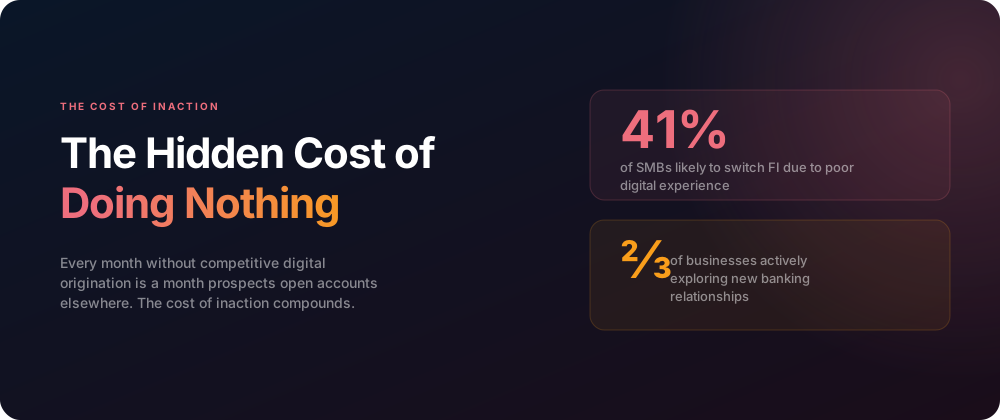
Perhaps the most important ROI calculation is the one most institutions don’t make: the cost of inaction. Every month without a competitive digital origination experience is a month where prospective members and customers are opening accounts elsewhere—often at fintechs or megabanks with seamless digital onboarding.
A recent survey found that 41% of SMBs are likely to switch their primary financial institution due to poor digital experience, and two-thirds are actively exploring new banking relationships. For consumers, the numbers are similar. The cost of not modernizing isn’t static—it compounds as competitors improve and expectations rise.
Making the Case to Your Board
For executives preparing a board presentation on digital account opening investment, the ROI framework is straight forward. Start with current acquisition costs and conversion rates as your baseline. Model the impact of a 60% improvement in conversion and a 60% reduction in per-account cost. Layer in cross-sell revenue uplift and geographic expansion potential. Then compare that to the total cost of ownership of the platform, including implementation, licensing, and integration.
For most institutions, the payback period on a well-implemented digital account opening platform is under 12 months. For many, it’s under six.
The Bottom Line
Digital account opening is no longer a “nice to have” or a project for next year’s roadmap. It’s a core growth lever with quantifiable, measurable returns. The institutions that are winning right now are the ones that treat digital origination not as a technology upgrade, but as a strategic investmentin acquisition, efficiency, and long-term member and customer value.
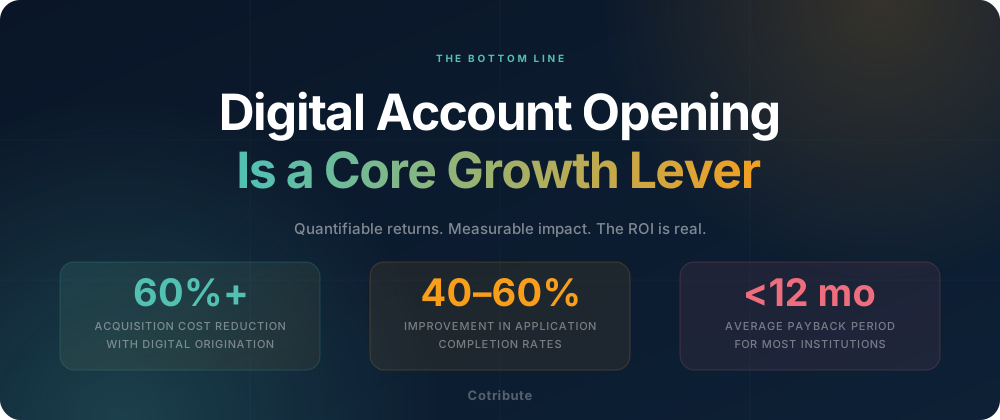
The ROI is real. The question is whether your institution is capturing it. Ready to see what digital account opening can deliver for your bottom line? Talk with us at Cotribute to benchmark your current performance and explore what’s possible.
About Cotribute
Cotribute is a digital account opening platform purpose-built for community banks and credit unions. We help financial institutions compete in a digital-first world by delivering seamless, mobile-optimized account opening experiences across all account types—including HSAs, checking, savings, business accounts, and more.
Our platform includes automated identity verification, fraud detection, real-time decisioning, and core system integration with compliance built in.
Learn more: www.cotribute.com
